+86 13315975815
 inquiry@htlcable.com
Transport & Storage
General Guidelines
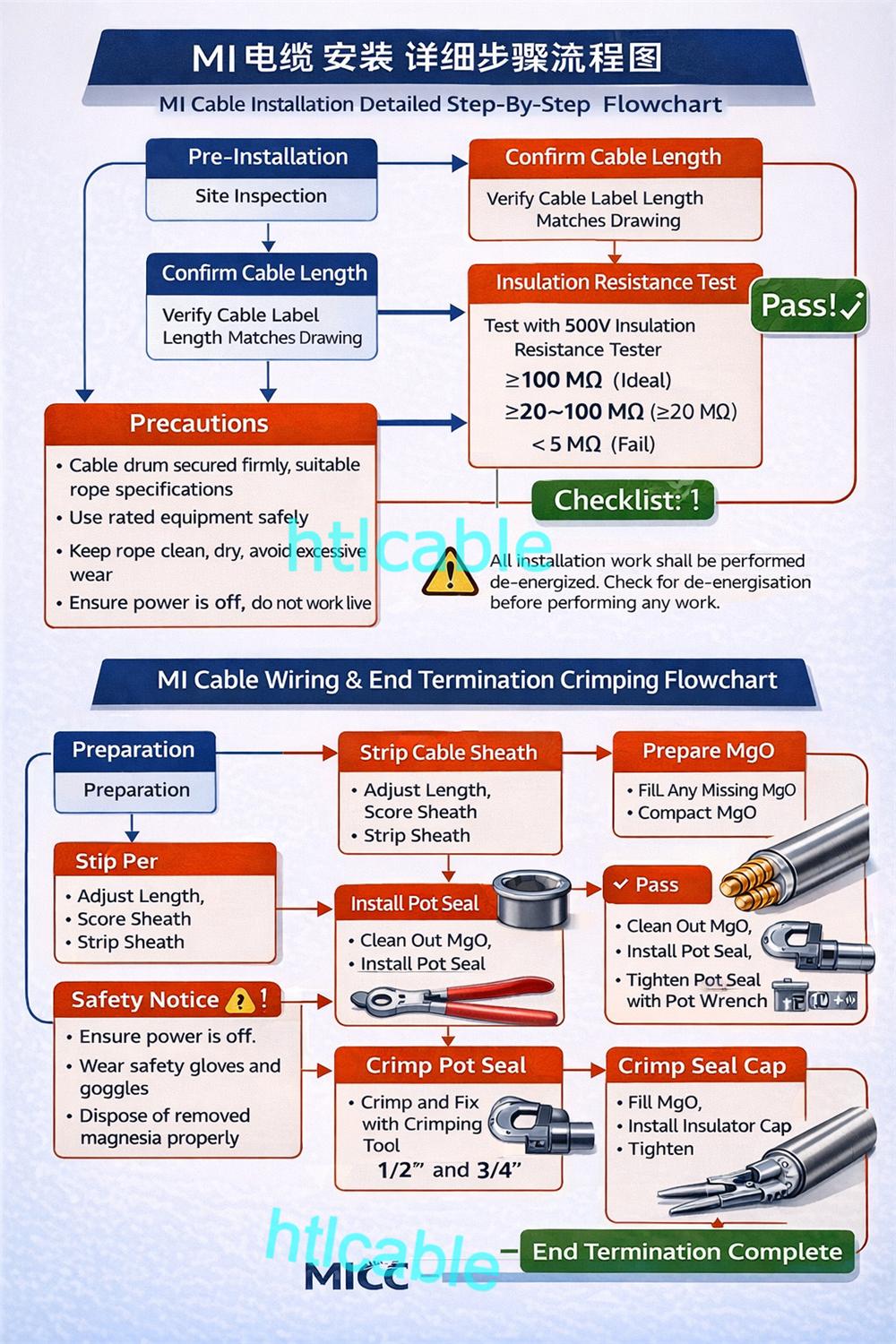
On receipt and before being held in storage we recommend the cable references are confirmed and insulation resistance (IR) is measured using a 500 volts insulation tester connected across the conductor(s) and the metallic sheath and conductor to conductor. It should not be less than 100 MΩ. However, site conditions may reduce this and a value of 20 MΩ is considered to be acceptable even in dry conditions. Wet conditions may reduce this even further but in any case, a value of <5 MΩ should be considered evidence of a problem to be investigated.
Like all electrical products, MICC has to be managed and stored appropriately. Cables should be stored to protect them against physical damage and the environment. Protection from construction equipment, falling objects, chemical spills, and other hazards should be considered in selecting storage areas and environments. Fencing or other barriers may be used to protect cables and reels against damage by vehicles or other equipment moving about in the storage area.
Cable Reels
Reels shall be stored upright on their flanges, not stacked. Handling shall be in a manner that prevents deterioration of and physical damage to the reel and the cable. Reels of cable must not be dropped from any height. Cable reels should be handled utilizing equipment designed for that purpose. Always load and store reels upright on their flanges and block securely.
Reels can be hoisted with a properly secured shaft extending through both flanges.
Cradle both reel flanges between fork tines.
Lower reels carefully from a truck using a hydraulic gate, hoist, or forklift.
Upended heavy reels will often be damaged. Do not lift by a single reel flange as cable or reel may be damaged. Never allow fork tines to touch the cable surface or reel wrap. Never drop reels. Lifting or handling of cable reels should be done in such a manner that the lifting/handling device does not make direct contact with the cable or its protective covering. Care shall also be taken so that the flange of one reel does not impact cable on another reel. If any of these cases occur, the cable shall be examined for damage.
The following methods are recommended for the lifting of cable:
- A crane or boom type equipment may be used by inserting a suitable shaft, which is properly secured, through the reel arbor hole and lifting with slings. A spreader or other device should be used to minimize sling pressure against the reel flange.
- Forklift type equipment may be used to move smaller, narrower reels. Fork tines should be placed so that lift pressure is on the reel flanges, not on the cable, and must reach across the reel so the lift is against both reel flanges.
- Reels may be moved short distances by rolling. Reels should be rolled in the direction that the cable is wound. This will tend to tighten the cable windings, not loosen them. Surfaces over which the reels are to be rolled should be firm, level, and clear of debris including protruding stones, stumps, and other material that may damage the cable if the reel straddles them. Make sure there are no objects in the way that could damage the cable surface by preventing the reel flanges from bearing the total weight.
If a cable is transferred to another reel, the drum diameter of the reel shall be equal to, or greater than the original reel drum diameter. Reel flanges should be in good condition to prevent damage to the cable. The reel should be capable of accommodating the cable length with at least 1 1/2 inches of clearance below the top of the flange. The reel shall have an adequate weight capacity. Care shall be taken to assure that cable limits for bending radius are not violated and the cable is not twisted during rereeling or installation. Appropriate precautions for reeling and unreeling should be followed. Identification and/or marking information shall be transferred to the new reel using a permanent marking method.
Cables shall be handled carefully during unreeling to prevent damage due to kinking or bending to radii smaller than allowable limits. During handling, cables shall not be laid on rough ground, run over, dragged over sharp objects, or other such treatment that could cause damage.
To prevent cables from settling into soft ground and prevent reels from rotting, storage should be on a firm surface, paved if possible, or on planking in an area with good drainage. For these reasons, storage of cable should, preferably, be indoors.
MICC can be supplied in coil form.
In most cases there are no plastics used in MICC cables, care should be taken in cryogenic conditions.
The cables should be stored vertically and payoffs/swifts should be employed to ease cutting and installation.
Although copper has immense resistance to many corrosive agents, heavy concentrations of acids or alkalis may harm the cable.
A close-fitting seamless LSF jacket can be extruded over the copper sheath, providing an extra safeguard against almost any kind of corrosive substance.
Storage
Cables are protected from the direct effects of weather with wrapping or lagging when shipped. When received, the protective covering or wrap on the cable should be inspected for evidence of shipment damage. Whenever possible, the factory-applied protective cover should be left in place until removal is necessary. The additional covering should be used to protect against the effects of the environment in which the cable is stored, such as outdoors or in excessively dirty, dusty areas. The cover should be resistant to the environment and should be chosen to shield cables from the deleterious effects of the sun. If possible, ventilation should be provided to dissipate any heat buildup. Both ends of the cable on a reel should be securely fastened to the reel flange and sealed to prevent the entrance of moisture. When shipped, the exposed ends of MICC cables are protected by shrinkable, molded polyolefin end caps. These caps are weatherproof and should adequately seal the cable against moisture and other contaminants during shipment and storage. Whenever end seals are damaged, missing, or removed look for moisture in the cable. If moisture is found, use suitable measures to dry the cable core and rectify any deleterious effects of the moisture, such as corrosion, before installation. If storage is outdoors or in an environment where considerable dirt and moisture are present, protection of the exposed cable ends with shrinkable, molded polyolefin end caps or other suitable means is recommended.
Packaging and Handling
It will be obvious that in certain circumstances the packaging of cables, e.g. large heavy drums, or sharp edges of metal components of cables could constitute a safety hazard and individuals should therefore take due care for their safety when handling these items.
Disposal of Scrap Cable
When disposing of cable scraps, special attention must be paid to current legislation.
General
When MI cable is stripped and terminated, cut metal edges can cause abrasions to the hands and loose powder may cause irritation if it enters the eyes.